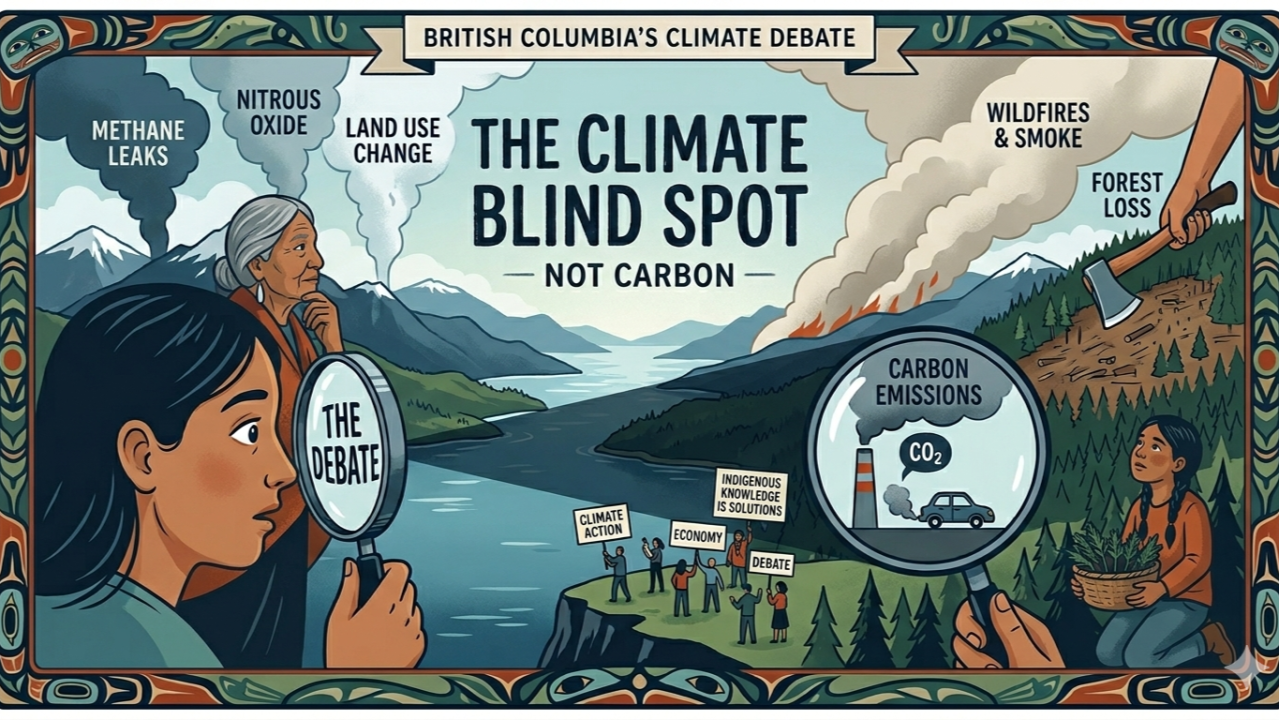
British Columbia’s Climate Debate Has a Blind Spot And It is Not Carbon
When people speak about protecting nature in British Columbia, the image that often comes to mind is vast, untouched wilderness, mountains, forests, rivers stretching beyond human presence. It is a powerful image. But it is incomplete.
British Columbia is not empty land. It never has been.
Long before the province joined Canada in 1871, the land was home to and governed by Indigenous Nations. Today, there are more than 200 distinct First Nations across British Columbia, many of whom did not sign historical treaties surrendering their territories. This reality is not simply historical; it is legal. In Delgamuukw v. British Columbia (1997), the Supreme Court of Canada affirmed that Aboriginal title exists in Canadian law. Later, in Tsilhqot’in Nation v. British Columbia (2014), the Court recognized Aboriginal title to a specific area of land for the first time. These decisions clarified that land governance in British Columbia is shared in ways that are constitutionally protected.
Understanding this legal and historical context is essential when discussing climate policy in the province.
Climate change in British Columbia is no longer a distant or theoretical issue. In 2021, the province experienced an extreme heat event that, according to the BC Coroners Service (2022), contributed to 619 deaths. Days later, wildfires destroyed much of the village of Lytton. That same year, severe flooding disrupted highways, supply chains, and communities. These events affected public health, infrastructure, and economic stability. Climate impacts are now part of daily life.
At the same time, British Columbia’s economy includes forestry, mining, and energy sectors that support thousands of families and communities. As debates around old-growth logging and land protection have intensified, public conversations have sometimes become polarized. Some voices emphasize environmental protection and climate urgency. Others focus on employment, economic survival, and regional livelihoods. Both concerns are valid. Both are rooted in lived realities. However, these debates often overlook a critical dimension: Indigenous governance.
In 2019, British Columbia passed the Declaration on the Rights of Indigenous Peoples Act (DRIPA), becoming the first province in Canada to formally commit to aligning its laws with the United Nations Declaration on the Rights of Indigenous Peoples (UNDRIP). Among other principles, UNDRIP emphasizes free, prior, and informed consent. The implementation of DRIPA is ongoing and complex, but its passage reflects a structural shift in how land and resource governance is understood. Indigenous Nations are recognized not merely as stakeholders, but as rights-holders. This shift is not abstract. It has practical implications for how climate policy, conservation, and economic development intersect.
There are already examples in British Columbia where collaborative approaches are being developed. The Great Bear Rainforest Agreements, negotiated over many years between Coastal First Nations, the provincial government, environmental organizations, and forestry representatives, protect significant portions of old-growth forest while permitting ecosystem-based forestry in designated areas. Indigenous Guardian programs, supported through Indigenous and federal initiatives, create local employment while strengthening environmental stewardship and monitoring. The First Nations Climate Initiative brings together Indigenous leadership to advance climate policy priorities at the provincial level.
These initiatives do not eliminate disagreement or complexity. However, they demonstrate that environmental protection and economic participation are not always mutually exclusive. When governance structures are inclusive and clearly defined, solutions can be more durable.
From my own journey in sustainability and climate communication, I have become increasingly aware that much of the polarization surrounding climate issues is not only about policy choices. It is also about framing. Climate discussions are often presented in technical language emissions targets, carbon pricing mechanisms, regulatory frameworks. While these tools are important, they can feel distant from everyday experience. Yet climate impacts appear in tangible ways: rising insurance costs, food price fluctuations, infrastructure vulnerability, employment uncertainty.
When communication fails to connect policy mechanisms to lived realities, misunderstandings grow. And where misunderstandings grow, polarization often follows.
British Columbia offers a complex but instructive case. The province sits at the intersection of climate urgency, resource-based economies, and evolving Indigenous governance. Treating nature as separate from people or as disconnected from law, livelihoods, and history oversimplifies this reality.
Nature in British Columbia is not empty wilderness. It is governed land. It is economic foundation. It is cultural identity. It is legal territory.
Effective climate conversations must reflect that complexity. They must recognize ecological limits, economic needs, and Indigenous rights simultaneously, rather than positioning them as competing forces.
As someone in this space, I am convinced that durable climate solutions depend not only on scientific evidence and regulatory tools, but also on clarity, transparency, and inclusive governance. The way we frame the conversation shapes the outcomes we consider possible.
Perhaps the most important starting point is simply acknowledging what is already true: the land has never been empty. Any climate strategy that overlooks that reality will struggle to build trust or lasting progress.
Sources
- BC Coroners Service (2022). Extreme Heat and Human Mortality: A Review of Heat-Related Deaths in B.C. in Summer 2021.
- Supreme Court of Canada. Delgamuukw v. British Columbia (1997).
- Supreme Court of Canada. Tsilhqot’in Nation v. British Columbia (2014).
- Government of British Columbia (2019). Declaration on the Rights of Indigenous Peoples Act (DRIPA).
- Great Bear Rainforest Agreements (Government of BC & Coastal First Nations).
- Indigenous Leadership Initiative – Indigenous Guardians Program.
- First Nations Climate Initiative (FNCI).

Leave a Reply